
Why Learning Frameworks Must Evolve from Skill-Building to Sense-Making
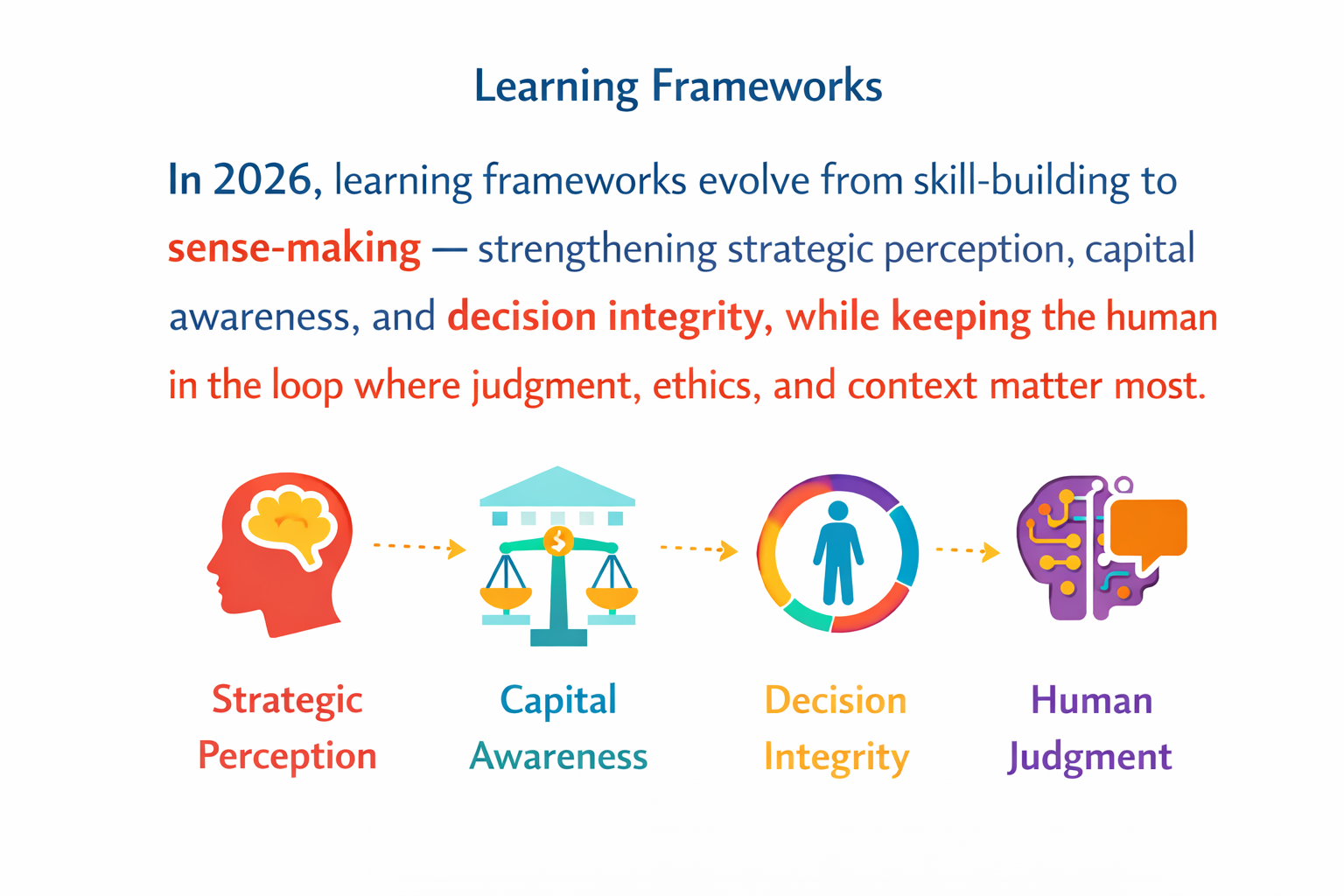
In a world where change accelerates daily, organizations that cling to traditional training—checklists of skills and competency matrices—are increasingly at risk of strategic obsolescence. By 2026, the once-comfortable boundary between learning and strategy has vanished. Learning frameworks are no longer about skill-building alone; they must equip leaders and organizations with strategic perception, capital awareness, decision integrity, and a deliberate human in the loop where judgment, ethics, and context matter most.
From Learning as Activity to Learning as Strategic Sense-Making
For decades, corporate learning has focused on upgrading skills and competencies to match anticipated needs. But in today’s unpredictable environment, the real challenge is not what leaders know, but how they interpret and act on emerging signals.
This shift is not anecdotal — forward-looking research shows that learning must respond to business change in real time rather than through static curricula separate from work itself. Experts predict that as organizations face sustained velocity in market and technology shifts, learning systems must adapt quickly and continuously.
Moreover, L&D leaders increasingly recognize that learning must be strategy-first — aligned with core business outcomes rather than isolated as an HR function or operational cost.
Strategic Perception: Reading Weak Signals Before They Become Crises
At its core, sense-making is about interpreting signals — early indicators of structural shifts in markets, customer expectations, competitive behaviors, and risk environments — before they ossify into problems.
This resonates with long-standing organizational theory: organizational metacognition — knowing what an organization knows and what it does not — is vital for adapting effectively in uncertainty.
In 2026, strategic perception means equipping decision-makers to discern meaningful patterns from noise, contextualize emerging information, and draw disciplined insights that guide direction rather than reaction. This is not skill acquisition — it is adaptive cognition, and it requires deliberate integration of learning with strategic processes.
Capital Awareness: When Balance Sheets Are Strategy
Today’s leaders must understand that capital structure is a strategic axis, not a finance silo.
As strategic priorities compress time horizons and magnify downside risk, learning frameworks must ensure that leaders don’t just make decisions, but make decisions that account for capital realities — liquidity timing, leverage risk, and stress scenarios. This isn’t taught through generic courses; it is cultivated through learning loops that integrate financial insight with strategic judgment.
Organizations that fail to embed capital thinking into their leadership DNA risk encountering the same systemic blind spots that have derailed major brands in recent years — where debt burdens and structural misalignment outpaced strategic attention.
Decision Integrity: Guardrails in a World Driven by AI and Speed
By 2026, artificial intelligence is no longer a futuristic concept — it’s a pervasive force reshaping how work gets done and how decisions are made. Gartner warns that poorly governed AI decision automation poses real risks and that ethical, explainable systems will be non-negotiable.
Learning frameworks must therefore evolve to blend human judgment with machine insight, preserving human oversight — human in the loop — in all high-stakes scenarios. This is not about resisting AI but embedding frameworks that ensure ethical, contextualized, and explainable decisions.
This aligns with trends where technology is increasingly intertwined with learning and development strategy, and where fluency (not just access) with tools becomes essential.
Human-Centered Learning: The Last Competitive Advantage
As organizations build AI-augmented systems, the value of the uniquely human elements — empathy, ethical reasoning, ambiguity tolerance, and contextual judgment — has never been higher. Across 2026 learning trend research, human-centered leadership, adaptability, and strategic thinking are repeatedly cited as the top skills organizations cannot outsource to machines.
Organizations that elevate human capacities within learning frameworks gain a deeper competitive edge — not because they have more data, but because they can interpret data through a lens of lived experience, ethical context, and strategic purpose.
Integrating Learning with Strategic Systems
To be future-ready, learning frameworks must be fully integrated into strategic, operational, and governance systems, not relegated to a corner of HR or talent development. This means:
Embedding learning into workflows and decisions, not just workshops or modules.
Connecting learning outcomes directly to business performance metrics such as risk mitigation, capital resilience, and strategic agility.
Designing feedback loops that transform every decision into a learning opportunity — especially where judgment and ethics are tested.
This is organizational learning at scale — where learning becomes a function of every decision, every action, and every pivot the company makes.
Conclusion: Learning Frameworks as Strategic Infrastructure
In 2026, the landscape of learning has fundamentally shifted:
Learning frameworks evolve from skill-building to sense-making — strengthening strategic perception, capital awareness, and decision integrity, while keeping the human in the loop where judgment, ethics, and context matter most.
This transformation makes learning a strategic infrastructure, not a support function. It enables boards and leaders to see around corners, make prudent choices under pressure, and govern with both insight and integrity.
Organizations that cling to outdated definitions of learning will find themselves reactive, brittle, and ill-prepared. Those that embrace learning as a strategic, integrated, human-anchored system — will shape the future.