
Frameworks for Ethical AI & Governance
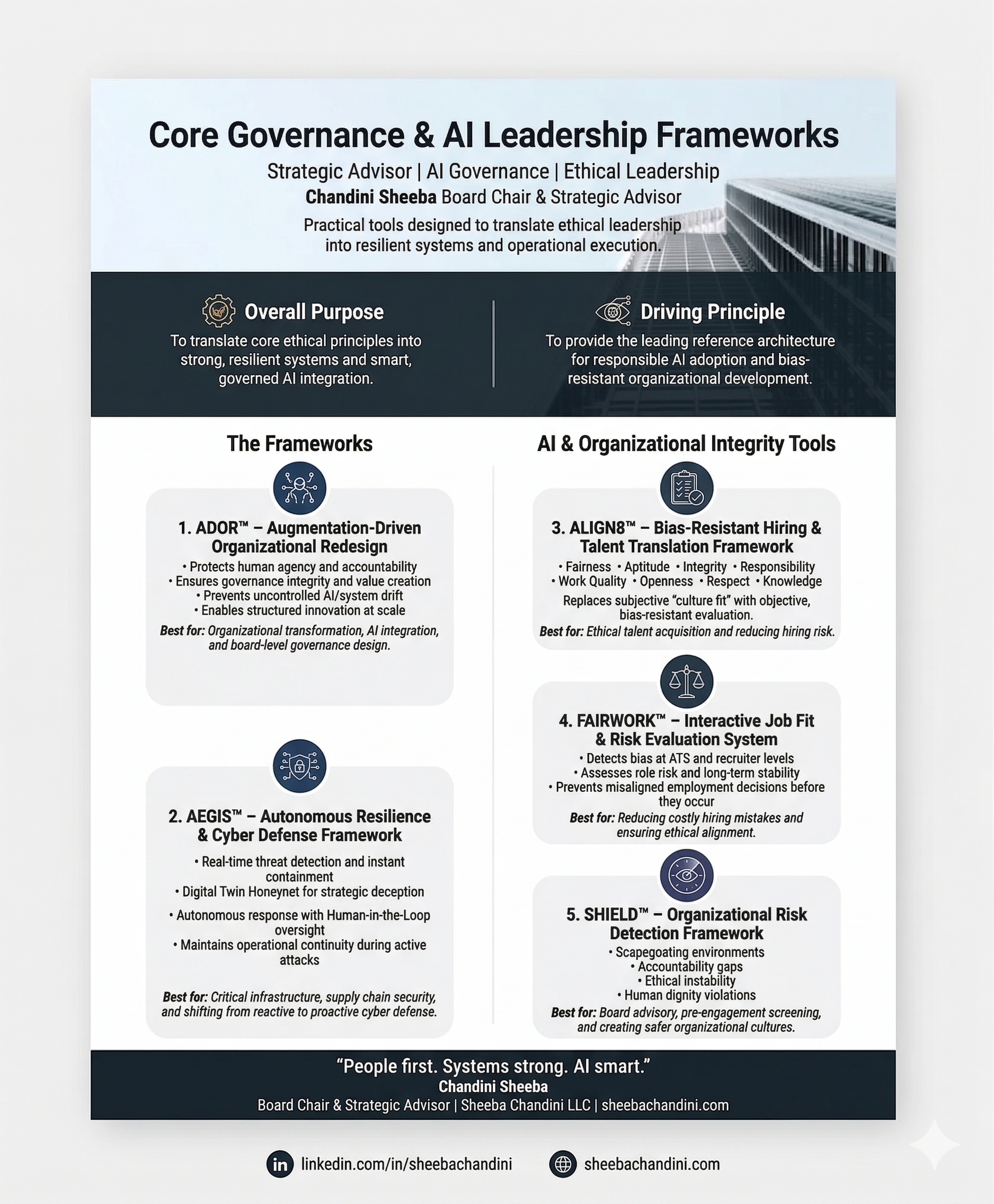
In today’s rapidly evolving AI landscape, leadership is no longer defined by vision alone—it is defined by how effectively that vision is translated into systems that are ethical, resilient, and scalable.
The challenge is not a lack of tools. It is a lack of structured frameworks that bridge human intention with technological execution.
This is where governance-led design becomes essential.
8 Key Principles Behind the Frameworks
1. People First, Always
AI must enhance human dignity—not replace judgment, accountability, or agency. Every framework begins with human-centered design.
2. Governance Before Scale
Scaling AI without governance creates risk. Structure must come before expansion to prevent drift and unintended consequences.
3. Accountability is Non-Negotiable
Clear ownership ensures decisions are traceable. Systems must define who is responsible, not just what is automated.
4. Bias is a System Risk, Not Just a Data Problem
Bias does not live only in datasets—it exists in processes, assumptions, and decision pathways. It must be addressed structurally.
5. Structure Enables Innovation
Contrary to common belief, governance does not slow innovation—it enables safe, scalable innovation.
6. Human-in-the-Loop is a Strategic Advantage
Autonomy without oversight increases risk. Intelligent systems must operate with human judgment embedded at critical points.
7. Alignment Over Assumptions
From hiring to AI deployment, alignment with mission, values, and long-term goals must replace subjective decision-making.
8. Prevention is More Valuable Than Correction
The strongest systems detect and prevent issues before they escalate—whether in hiring, governance, or cybersecurity.
3 Practical Examples in Action
Example 1: Organizational Transformation (ADOR™)
A company implementing AI across departments used ADOR™ to redesign its structure.
Instead of fragmented adoption, governance was embedded from the start—resulting in controlled scaling, reduced risk, and measurable value creation.
Example 2: Ethical Hiring & Talent Alignment (ALIGN8™ + FAIRWORK™)
An organization struggling with mis-hires replaced subjective “culture fit” decisions with structured evaluation frameworks.
This reduced bias, improved long-term retention, and strengthened workforce integrity.
Example 3: Cyber Resilience & Risk Prevention (AEGIS™ + SHIELD™)
In high-risk environments, proactive threat detection combined with organizational risk screening prevented escalation.
The system shifted from reactive firefighting to continuous, structured resilience.
Conclusion: From Vision to Execution
Ethical leadership is not a statement—it is a system.
The future of AI will not be defined by how advanced our tools become, but by how responsibly they are governed. Organizations that lead will be those that translate principles into practice—designing systems that are strong, intelligent, and human-centered.
People first. Systems strong. AI smart.